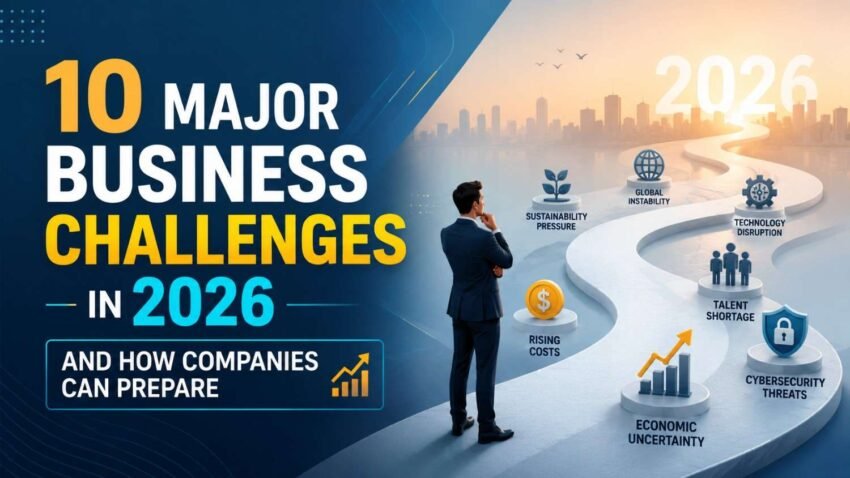
Running a business in 2026 takes way more than just having a good product and a solid sales plan. Most companies are basically operating in a place where technology is shifting quickly, customers want more, cyber threats are getting sharper and more clever, and yeah economic plus geopolitical uncertainty can flip decisions almost overnight. For smaller businesses, this gets extra tricky because budgets stay tight, and the number of available people or tools feels limited, so managing all that stuff becomes more of a daily puzzle.
Still, the hopeful part is that uncertainty does not automatically translate into bad business outcomes. Organizations that spot emerging risks early can end up making smarter calls, safeguarding their assets, and finding openings before competitors even notice. So when you zoom out from business challenges in 2026, and yes, artificial intelligence alongside cybersecurity, workforce transformation, rising costs, and shifting customer expectations, the real answer is a flexible strategy. It should balance expanding the operation with building resilience at the same time, without treating risk like a surprise.
1. Rapid Adoption of Artificial Intelligence
Artificial intelligence is one of those biggest opportunities AND challenges facing businesses in 2026, really. Companies are using AI for customer service , marketing, data analysis, software development, content creation, forecasting , and even workflow automation too. At the same time, rolling it out just because competitors are doing it can end up bringing unnecessary costs and a bit of chaos. The real issue seems to be figuring out where AI actually creates measurable value, not just where it sounds impressive. Businesses should pause and ask themselves things like does this tool save time. Does it improve accuracy, or does it increase revenue in a noticeable way. Or maybe it’s mostly about customer experience , like smoother support and quicker answers. Only after that kind of check makes sense, investing heavily should follow.
Businesses should:
- Identify repetitive processes suitable for AI.
- Calculate potential return on investment.
- Train employees to work effectively with AI.
- Review AI-generated outputs.
- Establish rules for responsible AI use.
A focused approach to adopting AI for businesses is usually more useful than trying to roll out dozens of disconnected tools, you know. Like instead of juggling a bunch of things at once.
2. Increasing cybersecurity threats
Cybersecurity is not just an IT department concern anymore. A successful cyberattack can interrupt day to day operations , expose customer data, trigger financial losses , and also damage a company’s reputation. Ransomware, phishing, credential theft, malware, and attacks against third party suppliers are still some of the most important risks. Smaller businesses in particular can be more exposed because they may have fewer resources set aside for security, honestly it can get tricky fast.
A practical small business cybersecurity strategy should include:
- Multi-factor authentication.
- Regular software updates.
- Employee security training.
- Strong password policies.
- Reliable backups.
- Access controls.
- Incident-response planning.
Cybersecurity should be treated more like an ongoing business investment, honestly rather than this thing companies only deal with after an incident happens. Like , it’s not just a fix-it later kind of effort.
3. Data privacy and regulatory pressure
Businesses increasingly gather customer information via websites, apps, payment systems, loyalty programs, and marketing platforms. As the amount of gathered data goes up, so does the burden—responsibility that is , tends to rise too. Privacy rules and sector expectations may end up changing across countries, states, and even across different industries. And if a business operates in more than one market, then they might need to sort through multiple rule sets, all at once. Companies should be able to explain what information they pull in, what the purpose is for that collection, where that information sits in storage, who can reach it , and how long the data should be kept before it’s deleted or otherwise retired.
Important steps include:
- Review existing data practices.
- Limit unnecessary data collection.
- Maintain clear privacy policies.
- Control employee access.
- Monitor third-party vendors.
- Document compliance procedures.
Strong data privacy compliance can also help build customer trust, because more folks now want to understand how businesses handle their information, like what is collected and why. It also signals that the company is serious about safeguarding data in practice, not just in the policy.
4. Economic Uncertainty and Rising Costs
Economic uncertainty makes planning kind of slippery. Shifts in inflation, interest rates, consumer spending, borrowing costs, and operating expenses can reach everything from staffing, to inventory management, to all those day to day decisions. If a business relies heavily on one revenue source, there can be extra pressure when demand shifts around. Instead of assuming that market conditions will just stay steady, companies should line up several scenarios, maybe with backup plans.
For example:
- What happens if sales decline by 10%?
- What happens if supplier costs increase?
- How long can the business operate with lower revenue?
- Which expenses can be reduced without damaging growth?
- Where could additional revenue come from?
So business financial planning should therefore take into account both growth targets, and some sort of contingency planning, kind of in tandem.
5. Geopolitical and supply chain disruptions
Global businesses are more and more affected by happenings outside their immediate reach. Things like trade restrictions, conflicts, sanctions, transport problems, tariffs, and regional instability can end up messing with suppliers and drive up costs. Even companies that don’t operate internationally can still get touched by it, when their suppliers rely on global markets. Firms can build resilience by really understanding where their critical inputs come from, and how dependent that connection actually is.
Useful approaches include:
- Developing alternative suppliers.
- Avoiding unnecessary dependence on one supplier.
- Maintaining appropriate inventory buffers.
- Monitoring international developments.
- Reviewing logistics risks regularly.
Strong supply chain resilience helps a business kinda pivot faster, when those random disruptions happen you know, without too much drama.
6. Workforce Transformation
The workplace keeps shifting, as remote work and hybrid models blend in with automation and AI, which sorta changes how employees do their day to day work. A few old tasks are starting to get handled by automation, but at the same time the need grows for technology focused skills, data handling, communication, problem-solving, and AI related know how. The tricky part for companies isn’t only deciding what jobs can be automated. It’s figuring out how the tech and the employees can actually cooperate in a practical way.
Companies should consider:
- Upskilling existing employees.
- Creating AI and digital literacy programs.
- Redesigning outdated roles.
- Supporting managers in hybrid environments.
- Improving internal communication.
- Identifying skills that will become more valuable.
A strong future of work strategy tends to focus more on how the workforce can adapt, rather than acting like technology is just a direct stand-in for people.
7. Employee Retention and Engagement
Getting skilled employees is only half the equation. The other half, actually keeping them, can be just as tough , maybe more. These days employees usually weigh flexibility, growth pathways, work that feels meaningful, how leadership runs things, compensation, and the general workplace culture when they decide if they stay with an organization. When turnover happens a lot, the costs don’t always show up right away, there are hidden expenses from hiring again, onboarding, training time, lost know how, and also reduced productivity.
Businesses can improve retention by:
- Providing clear career paths.
- Offering learning opportunities.
- Recognizing strong performance.
- Supporting reasonable flexibility.
- Training managers.
- Listening to employee feedback.
Employee retention should be seen as a strategic issue i guess, because seasoned employees usually keep a lot of important institutional knowledge, not just tasks. Losing them can quietly mess with continuity, even if everything looks fine on paper.
8. Changing Customer Expectations
Customers now have more options than before, they can compare products, prices reviews , and experiences within minutes. So, just having a good product may not cut it anymore. Customers tend to want businesses to deliver a smoother purchase flow, quick assistance, meaningful outreach, clear and transparent details, and service that stays consistent. Because of that, businesses should routinely take a full look at the customer journey, from start to end, and not only at the obvious parts.
Ask:
Where do customers experience friction?
It might be a slow website, a complicated checkout process, delayed support replies, unclear pricing, or maybe just confusing product details. If those parts get tuned a bit, you can end up with a stronger customer experience strategy, even if you don’t have to change the core product so much.
9. Maintaining Innovation Without Overspending
Innovation matters a lot for long term competitiveness, but it also gets costly when companies chase every new trend. The key is to separate innovation that truly solves a customer need or an operational snag, from tech that just looks impressive, in a kind of flashy way. A more sensible way forward is controlled testing, sort of a measured experimentation, instead of going all in at once.
Businesses can:
- Test new ideas on a small scale.
- Gather customer feedback.
- Measure results.
- Improve successful experiments.
- Stop initiatives that fail to create value.
This approach lets companies push business innovation in 2026 , while also keeping an eye on avoidable financial risk.
10. Rising rivalry
Digital technology has made many market entry barriers more or less disappear. A smaller company can now sell across borders, connect to buyers via social media, rely on advanced software, and compete in practice with bigger businesses. So it brings openings, but yeah it also tightens competition. Firms cannot lean purely on price, because the larger rivals usually have stronger purchasing power, and that difference matters more than people expect.
Instead, smaller businesses can compete through:
- Specialized expertise.
- Better customer service.
- Faster response times.
- Strong communities.
- Personalization.
- Niche products.
- Strong brand positioning.
A clear competitive strategy kind of helps companies figure out what makes customers choose them, instead of just copying what the bigger players do, ya know.
How Businesses Can Become More Resilient
The problems of 2026 are tangled together in practice. AI touches workforce planning, and cybersecurity touches customer trust. Economic uncertainty changes how investment happens. Geopolitical risks then ripple into supply chains, so it’s not one isolated thing. Because of that businesses need a connected way forward for resilience, not a bunch of separate fixes.
A practical framework includes:
Identify → Prioritize → Prepare → Test → Adapt
First, suss out the risks that might really mess with the organization , you know, in a material way. Then sort them by likelihood and also by how big the fallout could be, if it happens. After that, put together response plans that actually make sense , and try them out when you can test them in real life or at least in a controlled way. Keep revising everything, because conditions do not sit still , they shift. In the end, business resilience planning becomes this continual management thing rather than some sudden emergency exercise, right.
The value of scenario planning
No one can truly forecast every future event, but organizations can still gear up for multiple maybes. With scenario planning, the leadership team can look at a set of plausible circumstances, then decide the actions they would take in each case.
For example:
Scenario A: Demand increases rapidly.
Scenario B: Demand falls significantly.
Scenario C: A major supplier becomes unavailable.
Scenario D: A new competitor enters the market.
Scenario E: A critical technology becomes unavailable.
Thinking through these situations can help companies answer faster when things shift, and honestly it feels a little less chaotic.
Turning Business Challenges Into Opportunities
Challenges aren’t always, you know , threats. AI can cut out repetitive tasks. Cybersecurity spending can strengthen customer trust. Workforce training may boost employee capabilities. Then supply chain diversification can bring more steadiness.
Also, customer feedback might uncover fresh product openings, and that’s not just optimism. Economic pressure can nudge firms to remove needless expenses. The most resilient orgs tend to look past the immediate trouble and ask what kind of capability they can craft because of it. This way of thinking backs long-term growth strategies, even while the market is uncertain.
A Practical 2026 Business Action Plan
Businesses do not need to solve every challenge simultaneously.
A practical starting point is to focus on five priorities:
- Review financial resilience: Check cash flow, reserves, debt, and major cost risks.
- Strengthen cybersecurity: Audit access controls, backups, employee awareness, and security procedures.
- Evaluate AI opportunities: Select specific workflows where AI can create measurable value.
- Develop workforce skills: Identify the capabilities employees will need over the next few years.
- Review customer needs: Analyze changing expectations, feedback, purchasing behavior, and retention.
These actions can create a stronger foundation without requiring an organization-wide transformation overnight.
Conclusion
In 2026, businesses get hit with this mix of tech pressures, money problems, rules and regulators, workforce realities, competitive forces, and geopolitical tension that all kind of demand more flexible thinking then the usual business plan stuff. AI adoption and cybersecurity, data privacy and economic uncertainty, supply chain hiccups and employee retention, customer expectations, plus innovation are not just separate problems. They rub into each other and pretty fast can nudge overall performance up or down. So the best response, at least in my view, isn’t trying to predict every single disruption that might show up. It’s more like building an organization that can adapt, with solid financial discipline , capable people, secure systems, dependable data, diversified operations , and also the attitude to test and learn . If a company prepares early, then uncertainty can turn into a real chance to become more efficient, more resilient, and more competitive.
Frequently Asked Questions
1. What are the biggest business challenges in 2026?
Major challenges include AI adoption, cybersecurity, data privacy, economic uncertainty, supply chain disruption, workforce transformation, changing customer expectations, and increasing competition.
2. How can small businesses prepare for economic uncertainty?
Small businesses should monitor cash flow, maintain appropriate reserves, control unnecessary expenses, diversify revenue where practical, and use scenario planning to prepare for changing conditions.
3. Why is AI a challenge for businesses?
AI can create significant opportunities, but implementation costs, employee training, data quality, security, governance, and uncertain ROI can make adoption difficult without a clear strategy.
4. How can businesses improve cybersecurity?
Businesses should use multi-factor authentication, strong access controls, regular updates, employee security training, secure backups, and documented incident-response procedures.
5. What is the best way to prepare for future business challenges?
Focus on resilience rather than prediction. Strengthen finances, technology, cybersecurity, employee skills, customer relationships, data systems, and the ability to adapt quickly.