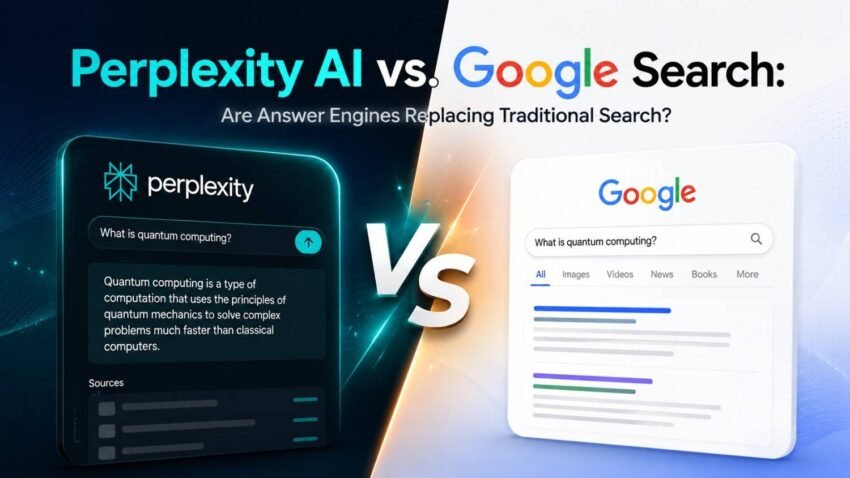
Getting accurate information online now feels sort of easier but also more difficult. Search engines can open up billions of pages, yet many people still end up wasting time clicking through several links just to reach something they can actually trust. And it’s not just time, it’s also the annoyances along the way. Sometimes search results are cluttered with ads, sometimes the info is already outdated, or the content just doesn’t really answer the question in a clean way. So with everyone expecting faster results and less hassle, the push for smarter search experiences keeps rising, a lot more than before.
This is why answer engines, like Perplexity AI, are starting to reshape how people look things up. Instead of handing you a list of websites, these AI tools can craft a direct response by pulling ideas from multiple sources. At the same time, Google Search is rolling out more artificial intelligence inside its own search flow, so now traditional search and AI written answers show up next to each other. The real point isn’t “if” AI will affect online search anymore, it’s more like figuring out whether answer engines might, eventually, fully replace the classic search engines entirely.
What Is Google Search?
Google Search has been kinda the world’s leading search engine for more than two decades now. Its main goal is to help people track down useful websites, by crawling, indexing, and ranking billions of web pages across the entire internet. Instead of handing you one single answer right away, Google shows a sort of list of search results, so users can pick the source they trust most, yeah.
Key Features of Google Search
Massive Search Index thing
Google indexes billions of web pages, making it one of the biggest sources of online information, basically. People can stumble upon articles, videos, images, research papers, products, news and a bunch more all through just one search, without the hassle.
Advanced Ranking Algorithms
Google’s ranking system looks at tons of factors, like relevance, authority, page quality, user experience, and how fresh the content is. It’s a kind of mix and match, to help serve useful results for all sorts of different requests, not just one.
Multiple Search Formats
Beyond the normal web results, Google also brings image search, video search, shopping results, local business listings, maps, news, and academic resources. So yeah, it’s a pretty comprehensive search platform, in practice, for real people.
Continuous AI Improvements
Google has added AI powered features that summarize details, tackle tricky questions, and improve search accuracy while still sending users back to the original websites.
What Is Perplexity AI?
Perplexity AI is a sort of AI powered answer engine that’s meant to make finding information a bit easier, honestly. Instead of throwing a bunch of blue links at you it will generate a conversational style reply, it reads what you’re asking and then blends ideas from several trusted sources. Most of the time each reply also shows citations, so you can check what’s going on without guessing.
Some Key things about Perplexity AI
Direct AI Answers
It won’t just make you jump around a bunch of separate pages. Instead, it gives a clear, well organized answer that pulls together the parts that seem most relevant.
Source Citations
Each response typically includes references, this way you can judge how solid the information really is.
Conversational Search Feel
You can ask follow up questions naturally, you don’t have to restart the whole search process every time. It feels more like chatting and refining, than doing that typical search session.
Fast Research
Because it brings together multiple reliable sources, it tends to cut down the time it takes to collect facts and compare perspectives.
Traditional Search vs. Answer Engines
Although both platforms help users find information, they follow different approaches.
Google Search Focuses on Discovery
Google is like a doorway to the web, it helps people stumble upon sites and compare views, shop online, read blogs, watch videos and find official resources too. In the end, the user has to decide what to trust after looking through what shows up in the results.
Perplexity AI Focuses on Answers
Perplexity tries to hand you an answer right away. Rather than telling you to hop across several websites, it reads and pulls from multiple sources, then gives a short, consolidated response with references. That can be handy for fast research and kind of quicker learning too.
Major Differences Between Perplexity AI and Google Search
1. Search experience
- Google throws a bunch of web pages at you based on a query, so users kinda get to wander around and look from different angles. It is great when the goal is broad research, or when you want to stumble on new websites you didn’t even know about.
- Perplexity AI goes a different route, it tends to give you a direct reply, which saves time because you don’t have to open 10 tabs right away . Honestly it feels more like a talk, not just hunting through results, and it can be pretty efficient for straightforward, factual questions.
2. Information sources
- Google basically indexes almost every website that’s publicly available and then it ranks the material by relevance and quality. From there users can jump into official pages, company blogs, forums, news outlets and even academic papers.
- Perplexity AI pulls in details from multiple trusted sources and then it boils it down into one single response , with citations or references attached, so you can trace where the ideas came from.
3. User interaction
- With Google, if you need more info , you usually have to tweak the search yourself. Each time you run a new search it’s often treated like a brand new query, even if you meant it as a continuation.
- With Perplexity AI, you can keep asking follow up questions inside the same conversation. So the workflow feels more natural, like research instead of repetitive searching.
4. Research efficiency
- Google can give more coverage, but yeah it often takes extra time to compare sources, read carefully, and double-check whether the facts actually match.
- Perplexity AI can speed things up by showing tight summaries first, which makes it useful for students, professionals, and everyday users who just want quick insights without spending ages sorting everything out.
Benefits of Google Search
• Access to a wider set of perspectives
Google taps into information from countless publishers, so people can weigh opinions, expert analyses, official documentation, and independent reviews before deciding on anything
• Helpful for shopping , nearby searches
When users are trying to compare products, check maps, browse restaurant listings, look up business details, or plan travel, Google keeps showing a very polished ecosystem
• Good for deeper research
Researchers often end up choosing Google, since it can point them toward academic papers, government sites, technical documentation, industry reports, and even more niche publications
Benefits of Perplexity AI
• Faster Answers
Perplexity really helps cut down research time, by producing more structured responses instead of making you browse a bunch of different sites.
• Easy-to-Understand Information
Because it talks in a conversational way, it makes complicated subjects easier to grasp for beginners, students, and even professionals who want quick explanations, right away.
• Transparent Citations
When it includes source references, users can check the information themselves, instead of depending only on AI output, so the whole thing feels more trustworthy and credible.
Can Answer Engines Replace Traditional Search?
Lately, the rising popularity of AI-powered answer engines has kicked off an important discussion inside the tech industry . A lot of users seem to want direct responses , not having to skim through dozens and dozens of websites. Still, swapping out classic search fully is a bigger challenge than people often think, since individuals use search engines for plenty of different aims beyond just grabbing quick facts. Instead of trying to replace Google Search overnight , answer engines will probably sit alongside traditional search . They fit best for people who need immediate, condensed information, while search engines keep their worth for deeper research, shopping, entertainment, route finding and stumbling onto new sites. In the end, these tools handle different needs , so they’re handy in different contexts and moments .
Reasons Why Answer Engines Are Growing
Faster Information Retrieval
People can get a full answer within seconds without jumping into a bunch of different websites. This feels like a time-saver, especially for students, professionals, and researchers who want fast clarification, not all the clicking.
Improved User Experience
With AI powered conversations, users can ask follow up questions in a more natural way. Rather than swapping keywords over and over, they can keep talking through the same thread, pretty much like you’d do with a human assistant.
Reduced Information Overload
Typical search results can show thousands, or even millions of options. Answer engines make it less messy by showing only the most fitting details, in a tight and easy to scan format.
Better Productivity
For folks building reports, decks, coding tasks, or research work, gathering information becomes smoother. AI can condense content from multiple sources into a single response, so you spend less time hunting and more time moving forward.
Why Google Search Is Still Difficult to Replace
Despite rapid advances in AI, Google Search continues to offer advantages that answer engines cannot fully replace.
Google’s Strengths
Comprehensive Web Access
Google gives pretty much access to nearly every kind of online content, including blogs, government websites , official documentation, videos , forums , news articles , academic journals, and online stores too.
Real-Time Information
Search engines are great for showing breaking news , live happenings , what products are in stock , local business info, and pages that get updated pretty often.
Website Discovery
A lot of people don’t just search for straight answers, they also want to stumble on new businesses, tools, communities, tutorials, and learning resources. Google stays the go-to platform for browsing and exploration in general.
Business Ecosystem
Google blends Search with Maps, Shopping, Images, YouTube, News, and other services, so you get a full digital environment that answer engines today simply can’t replicate.
The Impact of AI on SEO
Artificial intelligence is,kind of, changing the way people eat up online information, and that shift is nudging Search Engine Optimization or SEO too. Businesses really can’t just stay focused on getting to the top of search results anymore they also have to craft content that AI systems view as credible, correct, and genuinely useful. In other words, it’s not only about being ranked, it’s about being understood.
How SEO Is Evolving
High-Quality Content Matters More
AI systems prioritize content that provides accurate, well-structured, and genuinely helpful information instead of articles written only to rank for keywords.
Experience and Expertise Become Essential
Content backed by real-world knowledge, expert opinions, original research, and practical examples is more likely to build trust with both users and AI-powered search systems.
Clear Structure Improves Visibility
Articles with descriptive headings, short paragraphs, bullet points, and easy-to-read formatting are easier for both readers and AI models to understand.
User Intent Takes Priority
Modern SEO focuses on answering the user’s actual question rather than simply repeating keywords throughout the article.
EEAT: Why Trust Matters More Than Ever
Google’s EEAT framework Experience, Expertise, Authoritativeness, and Trustworthiness keeps sort of playing an important role in overall content quality, even now and it still matters. AI answer engines also kinda gain from trustworthy sources too, because they depend on credible info when they’re putting together their responses.
Best Practices for EEAT-Friendly Content
- Share practical knowledge and real-world examples whenever possible.
- Use reliable and authoritative sources to support factual claims.
- Keep content updated with the latest developments.
- Write in simple language that is easy for readers to understand.
- Maintain transparency by avoiding exaggerated or misleading statements.
Following these principles increases the likelihood that both search engines and AI-powered platforms will recommend your content.
Which Platform Should You Choose?
The best platform depends on your purpose rather than assuming one is better than the other.
Choose Google Search If You Want To
- Explore multiple viewpoints before making a decision.
- Compare products, prices, or services.
- Find official websites and documentation.
- Discover local businesses and nearby services.
- Conduct detailed academic or professional research.
Choose Perplexity AI If You Want To
- Receive quick, summarized answers.
- Understand complex topics more easily.
- Continue asking follow-up questions in one conversation.
- Save time during research.
- Get cited responses for faster verification.
The Future of Search
The future of online search is probably going to mix what used to be “just” traditional search engines with AI-powered answer engines. Rather than going head to head all the time, they seem to be leaning in together more often, sort of hand in glove, to create a better overall user experience. Search engines are starting to add AI summaries, and answer engines keep getting better at showing their work through source citations, plus more advanced reasoning, even when the wording feels a bit more natural. For businesses, publishers, and content creators, this basically means making content that can satisfy both real people and AI systems. So, the pieces should be useful, clearly arranged, factually reliable, and not just written to “rank”. If an organization gives more attention to quality than raw volume, it will usually end up in a stronger position as search keeps shifting, and the rules are never fully staying still.
Conclusion
Perplexity AI and Google Search are two different ways of finding information online. Perplexity AI leans toward fast, conversational, and source-backed answers, while Google Search keeps offering huge access to the wider web and a broader mix of viewpoints. So it’s less about replacing traditional search and more about how answer engines are changing the discovery process, giving people speed plus convenience. And as artificial intelligence keeps evolving, the content that tends to win is the one that stays accurate and trustworthy, remains centered on the user, and is tuned for both search engines and AI-powered answer platforms.
Frequently Asked Questions
1. What’s basically the main difference between Perplexity AI and Google Search ?
Perplexity AI gives you direct, AI generated answers, usually with source citations, while Google Search mostly surfaces lists of relevant pages for you to go dig around in. They kind of do different jobs depending on what kind of info you’re trying to get.
2. Can Perplexity AI totally replace Google Search ?
Not yet, not really. Perplexity AI is great for quick answers and research overviews, but Google Search is still better for finding websites, shopping, local searches, and getting access to a huge spread of online resources. So yeah, it’s more like, complementary, than full replacement.
3. Which platform is better for SEO research ?
Google Search is generally stronger for deeper SEO research, because it helps you reach blogs, case studies, official documentation, and multiple viewpoints all at once. Perplexity AI can help too, more as a rapid summary tool, or to quickly map concepts.
4. Why do answer engines keep getting more popular ?
Answer engines reduce the time cost, they hand you a concise conversational reply instead of making you open five or ten different sites. Plus, they can summarize what they find and handle follow up questions, which makes the whole research loop feel way faster.
5. How should businesses get ready for AI-powered search ?
Businesses should prioritize making original content that’s trustworthy, and also clearly structured, like it shows experience and real expertise. When they follow EEAT style principles, and match the user intent in a straightforward way, they improve visibility both in classic search engines, and in AI answer platforms too.