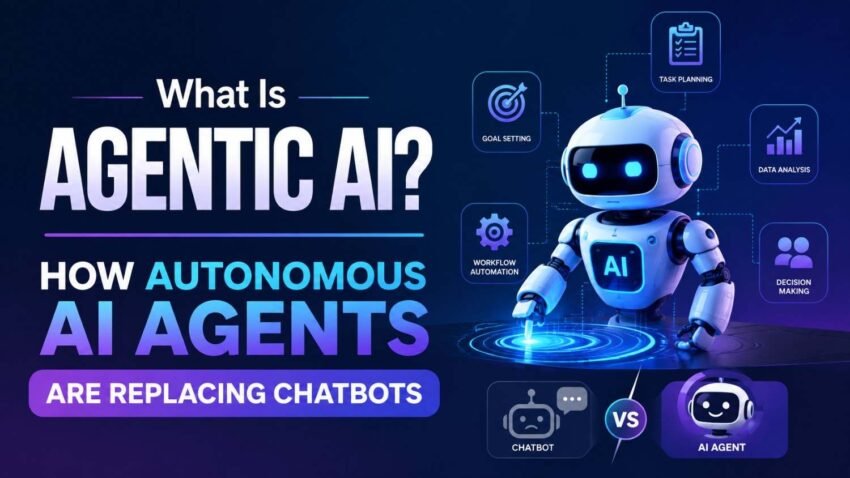
Artificial Intelligence has rapidly evolved over the past few years, sort of changing how businesses talk to customers, automate workflows, and boost productivity. For a lot of organisations, AI chatbots were the first move toward digital transformation, they helped answer frequent questions, handle more routine customer support issues, and deliver instant responses around the clock. But as business needs get more complicated, those older chatbots start showing their weak spots. They tend to depend on fixed scripts, they get stuck with multi step tasks, and they usually need a human in the loop when a conversation goes past what the bot was programmed to handle. Since customer expectations keep climbing, companies want AI that can reason more on its own, make informed choices, finish complicated work, and adjust to new circumstances without constant oversight.
Because of that, a newer kind of Artificial Intelligence has emerged, people call it Agentic AI. Unlike traditional chatbots that mostly answer questions, autonomous AI agents can look at goals, shape action plans, work with several software tools, handle problems, learn from results, and complete whole workflows with very little human involvement. Whether it’s running business operations and reviewing massive datasets, or helping with software development and streamlining customer service, Agentic AI feels like one of the most noticeable jumps in modern AI technology. This article digs into What Is Agentic AI? and How Autonomous AI Agents Are Replacing Chatbots, including how they work, where they’re used, what benefits show up, what challenges appear, and what the future may look like for businesses that adopt this strong technology.
What Is Agentic AI?
Agentic AI is basically Artificial Intelligence that can, on its own, chase goals , decide what to do, carry out tasks, and shift its behaviour when new info shows up. Instead of just replying to prompts the way classic chatbots do, these AI agents kind of plan things, think through them, and run multi step actions so they reach the desired outcome. An autonomous AI agent feels more like a useful digital assistant rather than a question-answering tool. Once a goal is given, it figures out what must happen , collects details chooses the right actions, works with different software applications, checks whether things are on track, and keeps going until the objective is finished.
Key Characteristics of Agentic AI
- Operates with minimal human supervision.
- Plans tasks independently.
- Learns from previous outcomes.
- Uses reasoning to make decisions.
- Interacts with multiple systems.
- Executes complete workflows.
- Continuously adapts to changing situations.
These capabilities make Agentic AI significantly more powerful than conventional conversational AI.
How Traditional Chatbots Work
Most chatbots are kind of built to answer questions, or keep a short back and forth conversation going. They usually recognize what you mean, pull up the most relevant information, and then craft an answer using training data or predefined steps. And sure, newer AI chatbots are a bit more advanced than the earlier rule based systems, but at the same time they stay reactive. They tend to wait for your instructions first, then act , and they rarely manage complicated chains of tasks all by themselves without you nudging them.
Typical Chatbot Functions
- Answer frequently asked questions.
- Provide customer support.
- Book appointments.
- Recommend products.
- Collect customer information.
- Offer basic troubleshooting.
These functions remain valuable but often require human involvement when tasks become more complicated.
How Agentic AI Is Different from Chatbots
The biggest difference lies in autonomy. Traditional chatbots reply to prompts , while agentic AI kind of works towards reaching goals. Instead of giving one single answer, an AI agent can handle a whole process. Say you ask it to organise a business trip, it might compare flights, arrange lodging, schedule meetings, update the calendar, ping the participants, and prepare the travel paperwork, all without needing you to tell it every little step separately .
Major Differences
- Chatbots answer questions; AI agents complete objectives.
- Chatbots react; AI agents plan.
- Chatbots perform isolated tasks; AI agents manage workflows.
- Chatbots rely on prompts; AI agents make decisions.
- Chatbots stop after responding; AI agents continue until goals are achieved.
This shift transforms AI from a conversational tool into an operational assistant.
How Autonomous AI Agents Work
Agentic AI merges a set of quite advanced technologies that let it kind of do autonomous choices. At the start, the system doesnt answer one lone question instead it gets a goal. Then it digs into what the objective really means, slices it into smaller duties, spots which resources are required, picks suitable software tools, performs each step, keeps an eye on the outcomes and, if anything looks off, it updates its plan.
Core Components
- Goal planning.
- Reasoning engine.
- Memory systems.
- Decision-making models.
- Software integration.
- Continuous learning.
- Feedback evaluation.
Together, these capabilities allow AI agents to operate with far greater independence.
Why Businesses Are Moving Beyond Chatbots
Organisations are increasingly needing automation that goes beyond just answering customer enquiries. In real business life operations are rarely “one step”, theres usually a whole tangle of things , like multiple departments , lots of software platforms , approvals here and decision points there. Agentic AI makes it possible to automate these linked workflows in a more direct way than standard chatbots, which are more like a simple conversation layer.
Business Benefits
- Faster workflow execution.
- Reduced manual effort.
- Improved operational efficiency.
- Better customer experiences.
- Lower operational costs.
Businesses gain productivity while allowing employees to focus on higher-value work.
1. Customer Service Automation
Modern customer support extends beyond answering simple questions. Customers often require order updates, refund processing, account verification, appointment changes, and personalised assistance. Agentic AI can manage these complete service journeys by interacting with customer databases, payment systems, inventory platforms, and communication tools without transferring customers between multiple departments.
Practical Applications
- Processing refunds.
- Updating customer accounts.
- Managing subscriptions.
- Resolving service requests.
- Scheduling appointments.
- Support becomes faster and more personalised.
2. Sales and Lead Management
Sales teams spend significant time qualifying leads, scheduling meetings, updating customer relationship management systems, and following up with prospects. Autonomous AI agents can perform many of these repetitive activities automatically while ensuring no potential customer is overlooked.
AI Sales Tasks
- Qualify leads.
- Schedule meetings.
- Send follow-up emails.
- Update CRM systems.
- Generate sales reports.
- Sales professionals gain more time for relationship building.
3. Marketing Automation
Marketing increasingly depends on analysing customer behaviour, creating content, managing campaigns, and optimising performance. Agentic AI helps coordinate multiple marketing activities simultaneously while adjusting campaigns based on performance data.
Marketing Applications
- Campaign optimisation.
- Audience segmentation.
- Content recommendations.
- Email automation.
- Performance reporting.
- This creates more efficient marketing operations.
4. Software Development
Developers now use AI for much more than code completion. Agentic AI can analyse project requirements, generate code, identify bugs, suggest improvements, write documentation, run tests, and monitor deployment progress.
Development Support
- Code generation.
- Bug detection.
- Documentation.
- Automated testing.
- Deployment monitoring.
- Developers remain in control while increasing productivity.
5. Business Operations
Routine administrative work consumes considerable organisational resources. AI agents automate repetitive operational tasks while improving consistency and reducing human error.
Operational Examples
- Invoice processing.
- Document management.
- Data entry.
- Internal reporting.
- Workflow coordination.
- Automation improves organisational efficiency.
6. Research and Data Analysis
Research often involves collecting information from multiple sources before identifying meaningful insights. Agentic AI can gather information, compare datasets, summarise findings, identify trends, and prepare reports significantly faster than manual methods.
Research Tasks
- Market analysis.
- Competitor monitoring.
- Trend identification.
- Data summarisation.
- Report creation.
Decision-makers receive faster business intelligence.
Benefits of AI
The interest in Agentic AI is growing because it can do complicated work automatically. It does a lot of things that people usually do.
Major Advantages
Agentic AI has good things about it.
- It helps people get work done.
- It makes decisions faster.
- It can handle a lot of work at the time.
- It reduces the money that companies spend to run their businesses.
- It makes customers happy.
- It is available all the time.
- It makes sure that work is done the way every time.
- It makes sure that the information is correct.
- It responds quickly.
- It helps companies use their resources better.
These are the reasons why many companies are spending a lot of money on Agentic AI.
Challenges and Risks
Even though Agentic AI has good things about it there are some things that companies need to think about. Companies need to make sure that the decisions made by AI are fair and secure and align with what the company wants to do.
Common Challenges
There are some challenges that companies face when they use Agentic AI.
- People are worried about their information.
- There are risks to the security of the company.
- Agentic AI has to make decisions that’re fair.
- People need to check what Agentic AI is doing.
- It is hard to combine Agentic AI with systems.
- Companies need to follow the rules.
- The models that Agentic AI uses need to be good.
- Agentic AI should not be biased.
It is very important for companies to be responsible when they use Agentic AI.
Industries Being Transformed
Agentic AI is already changing industries. Industries Adopting Agentic AI. industries are using Agentic AI.
- Healthcare is using Agentic AI.
- Financial services are using Agentic AI.
- Manufacturing is using Agentic AI.
- Retail is using Agentic AI.
- E-commerce is using Agentic AI.
- Logistics is using Agentic AI.
- Education is using Agentic AI.
- Legal services are using Agentic AI.
- Human resources are using Agentic AI.
- Software development is using Agentic AI.
Each of these industries is benefiting from Agentic AI because it helps them work better.
Best Practices for Implementing AI
To use Agentic AI successfully companies need to plan carefully. They should not try to replace all of their systems, at once. They should start with the work that is repeated over and over.
Recommended Approach
Here is what companies should do.
- Find the work that is repeated.
- Decide what they want to achieve.
- Make sure that people are checking what Agentic AI is doing.
- Check how well Agentic AI is working.
- Protect the information that’s sensitive.
- Train the employees.
- Always try to improve the work.
If companies do it slowly they will reduce the risk of something going wrong with their businesses.
Agentic AI vs Generative AI
Even if people usually say the terms like they are the same thing, they still point to different capabilities. Generative AI is mainly about producing material, like text, images, code, or audio. Agentic AI takes those abilities further, and then it adds planning, reasoning, memory , use of tools, and the whole autonomous execution part. In a lot of today’s setups generative AI becomes sort of the “thinking” bit , while Agentic AI gives the ability to actually take action and reach goals. Together this can help companies automate not just content creation, but entire operating workflows too.
Human cooperation will still matter
A frequent misunderstanding is that autonomous AI agents will replace human workers completely. But in practice, most organisations are using AI to increase human performance not to remove it. People bring in creativity, ethical judgment, emotional intelligence, strategic thinking, and those layered decisions that AI cannot really match end to end. The best workplaces mix human know-how with AI efficiency, so employees can stay on innovation, customer relationships, and higher value problem solving… while AI handles the repetitive operational stuff.
Future Trends in Agentic AI
Agentic AI is expected to become this kind of core thing in digital transformation, across all kinds of industries. In the near future, systems will probably work together with multiple specialized AI agents, and they will coordinate enterprise-wide workflows, make decisions that get more and more sophisticated, and somehow integrate smoothly with the business software ecosystem. There are also ongoing jumps in reasoning models, memory architectures, multimodal abilities, plus real-time learning , and that will make autonomous AI agents more capable by default. And as governance frameworks get more mature, and businesses start trusting responsible AI deployment a bit more, Agentic AI should shift from being a competitive advantage into something more like a standard business capability
Conclusion
Agentic AI kind of feels like the next big evolution in Artificial Intelligence, not just another step beyond traditional chatbots that only answer prompts. When you mix autonomous planning, smart decision-making, workflow execution, and continuous learning, Autonomous AI Agents start reshaping how organisations approach AI automation and business automation. It’s not really about replacing human expertise, it’s more like amplifying it—these systems can lift repetitive tasks and also complex operational work so employees can keep their focus on creativity, strategy, and relationship building. And as the technology keeps moving forward, companies that adopt Agentic AI in a responsible way should be in a better spot to improve efficiency, deliver noticeably better customer experiences, and stay competitive in a world that’s getting increasingly driven by AI.
Frequently Asked Questions
1. What is Agentic AI?
Agentic AI refers to autonomous Artificial Intelligence systems that can plan, make decisions, perform multi-step tasks, and work towards achieving goals with minimal human supervision.
2. How is Agentic AI different from a chatbot?
Traditional chatbots mainly answer questions or respond to prompts, while Agentic AI can independently manage complete workflows, interact with software tools, and adapt its actions based on changing situations.
3. Which industries benefit most from Agentic AI?
Healthcare, finance, retail, logistics, manufacturing, education, software development, legal services, and customer support are among the industries already benefiting from autonomous AI agents.
4. Will Agentic AI replace human jobs?
Agentic AI is more likely to automate repetitive tasks than replace entire roles. Human skills such as creativity, leadership, ethical judgement, and strategic thinking remain essential.
5. Is Agentic AI safe for businesses?
When implemented with strong governance, security controls, human oversight, and responsible AI policies, Agentic AI can safely improve productivity, streamline operations, and support better business decision-making.